
Mixed-language processing
Archived Based on Text release 0.2.1
Mixed text requires an explicit routing policy. A set of detected languages is evidence for that policy, not a command to run every processor.
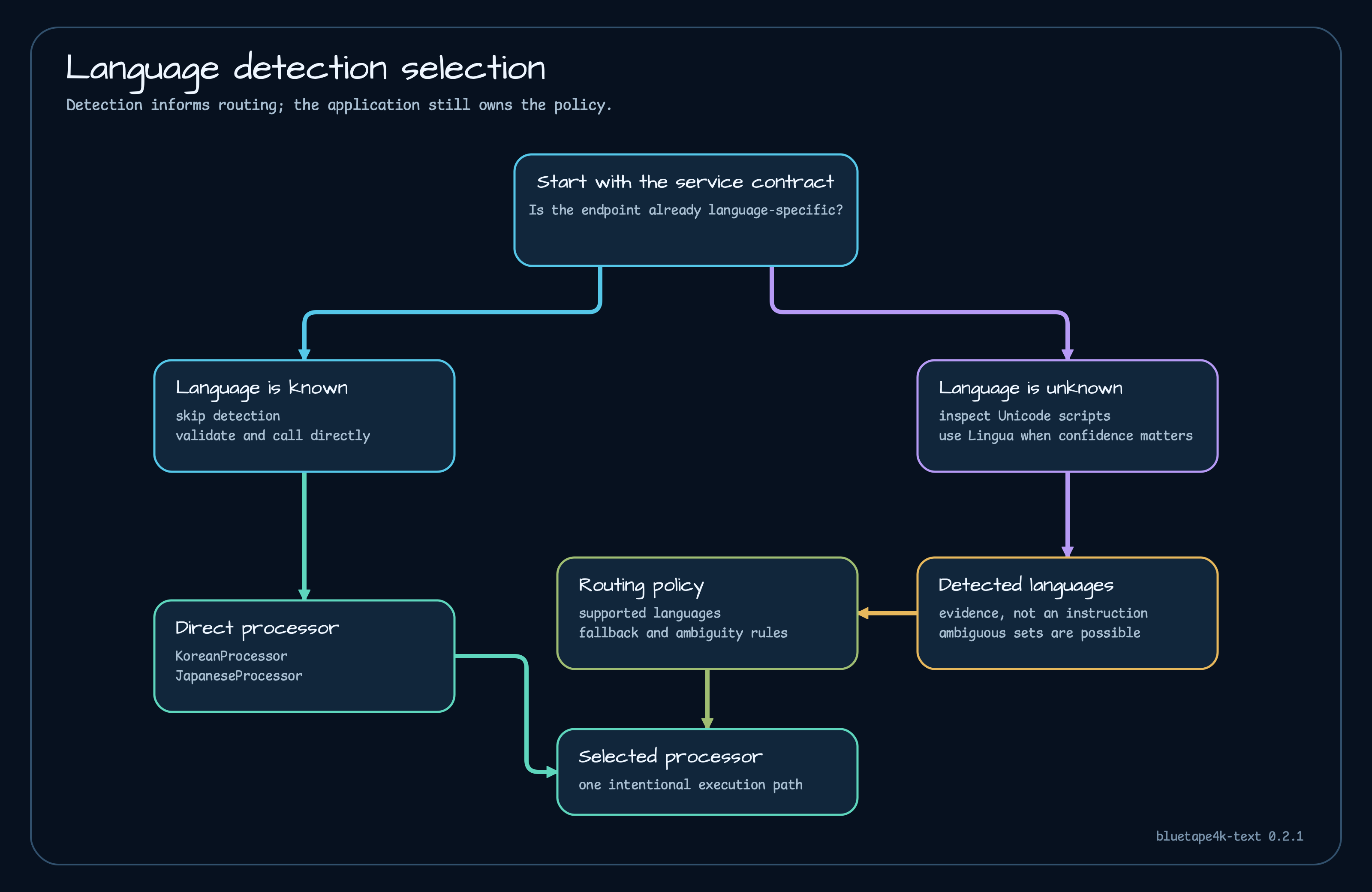
Start with the service contract
Section titled “Start with the service contract”If an endpoint is already language-specific, validate and call that processor. Detection adds cost and ambiguity without changing the route. Use detection when input language is unknown, when multiple language processors are supported, or when the product needs language metadata.
Use script evidence for fast routing
Section titled “Use script evidence for fast routing”import io.bluetape4k.lingua.UnicodeDetectorimport java.util.Locale
val unicode = UnicodeDetector()val hasKorean = unicode.containsAny("Hello 안녕하세요", Locale.KOREAN)val hasJapanese = unicode.containsAny("Hello こんにちは", Locale.JAPANESE)This detects character ranges, not language. It is reliable for the narrow script question and cheap enough for an early gate.
Use a restricted statistical detector
Section titled “Use a restricted statistical detector”import com.github.pemistahl.lingua.api.Languageimport io.bluetape4k.lingua.detectAllLanguagesOfimport io.bluetape4k.lingua.languageDetectorOf
val detector = languageDetectorOf( languages = setOf(Language.ENGLISH, Language.KOREAN, Language.JAPANESE), minimumRelativeDistance = 0.0, isEveryLanguageModelPreloaded = true, isLowAccuracyModeEnabled = false,)
val detected = detector.detectAllLanguagesOf("Hello. 안녕하세요. こんにちは。")Restricting the language set expresses product support and reduces unnecessary model scope. Reuse this detector.
Define ambiguity behavior
Section titled “Define ambiguity behavior”A practical route table might be:
| Evidence | Action |
|---|---|
| Korean only | call KoreanProcessor |
| Japanese only | call JapaneseProcessor |
| Korean and Japanese | split only if product rules define a safe segmentation strategy; otherwise return mixed/unsupported |
| Latin language only | keep as metadata or use a separate processor outside this repository |
| empty or ambiguous | return unknown, request a language hint, or apply a documented fallback |
Do not concatenate outputs from several processors and call that a single analysis unless offsets and ownership remain clear.
Preserve original text and offsets
Section titled “Preserve original text and offsets”Script-filtered substrings are useful for evidence but lose the full context. Keep the original input for trusted processing while avoiding it in error logs. If exact keyword offsets matter, run text-search on the original text or maintain an explicit mapping after segmentation.
Test real mixtures
Section titled “Test real mixtures”Include punctuation, numbers, short Latin tokens, Korean/Japanese sentences, and a no-language case. Assert the supported set and route decision separately. That keeps a future detector improvement from silently changing processor behavior.
Continue with the Lingua example, runtime boundaries, and failure contracts.