
Input safety
Archived Based on Text release 0.2.1
Validate untrusted text before tokenizer, dictionary, or model work. The 0.2.1 request models cap tokenizer and blockword text at 100_000 characters and reject blank input.
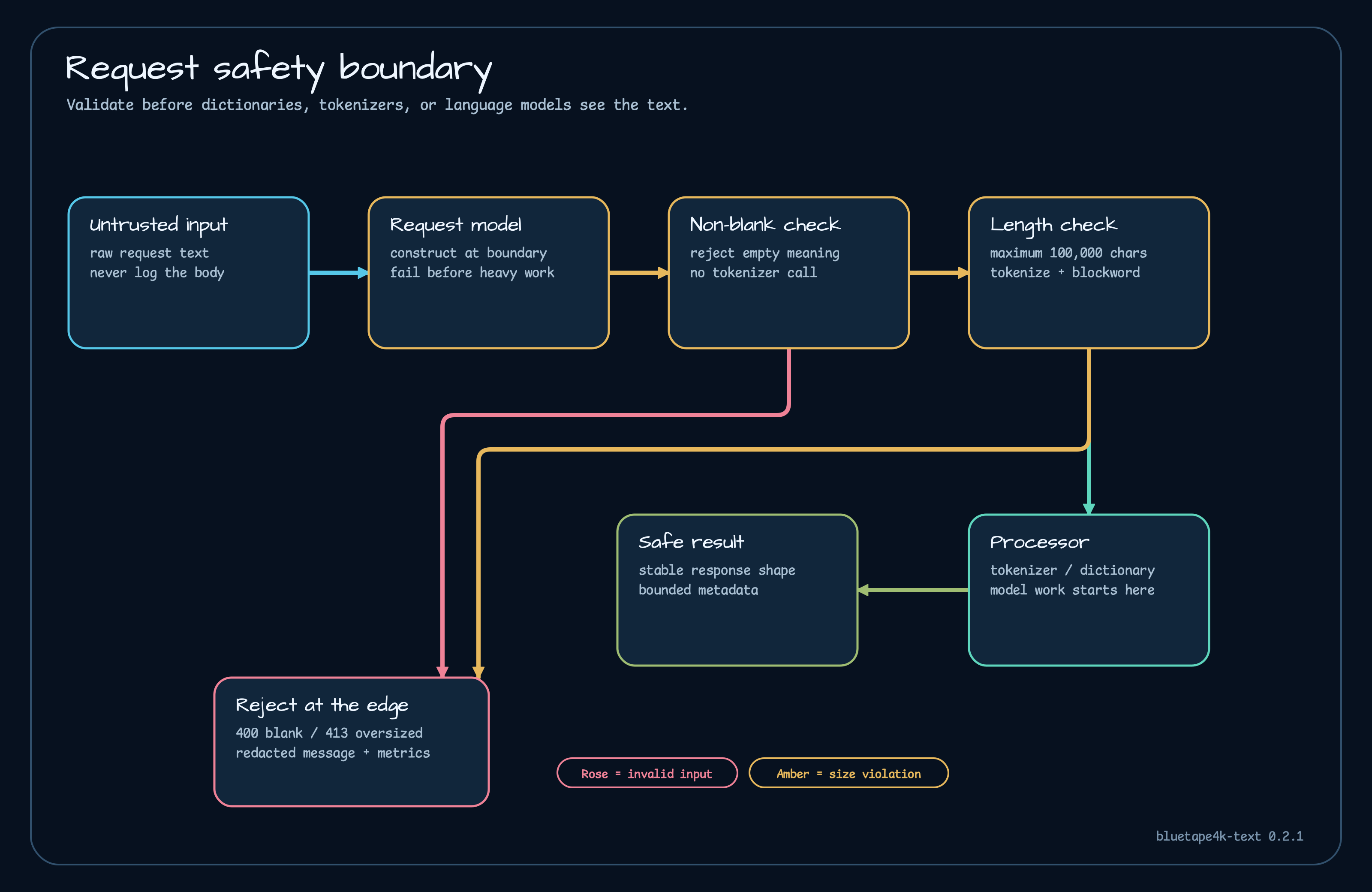
Map boundary failures explicitly
Section titled “Map boundary failures explicitly”import io.bluetape4k.tokenizer.model.MAX_TOKENIZE_TEXT_LENGTHimport io.bluetape4k.tokenizer.model.tokenizeRequestOf
fun tokenizeStatus(text: String): Int = when { text.isBlank() -> 400 text.length > MAX_TOKENIZE_TEXT_LENGTH -> 413 else -> { tokenizeRequestOf(text) 200 } }The adapter checks the same public constant as the model. Model validation remains the final guard if a caller bypasses the adapter.
Do not echo submitted text
Section titled “Do not echo submitted text”An invalid input may contain credentials, messages, or regulated data. Error bodies and logs should contain only:
- failure category;
- actual character length;
- configured maximum;
- a request or trace identifier governed by application policy.
The repository safety example deliberately reports metadata rather than raw text.
Separate invalid input from processor failure
Section titled “Separate invalid input from processor failure”| Case | Suggested HTTP mapping | Safe message |
|---|---|---|
| blank text | 400 | text is blank |
| over maximum length | 413 | text too long: <length> chars (max <limit>) |
| unexpected processor exception | 500 | processor error |
Do not collapse these into one retryable error. A caller can correct 400/413 input, while a processor failure needs service diagnosis.
Coroutines and cancellation
Section titled “Coroutines and cancellation”If the application calls processing inside a suspend boundary, rethrow CancellationException before broad exception handling. The runnable 0.2.1 safety example is synchronous around processors and uses runCatching; coroutine services should not copy that pattern around suspend calls because cancellation must propagate.
Add application limits when needed
Section titled “Add application limits when needed”The library maximum is a safety ceiling, not a performance target. An endpoint may choose a smaller limit based on latency, memory, or product requirements. Apply byte limits during transport parsing as well as character limits after decoding.
Verify the boundary
Section titled “Verify the boundary”Test blank, whitespace-only, exactly-at-limit, one-over-limit, processor exception, and sanitized output. The tokenizer safety example supplies a runnable starting point.