
Ktor integration
Archived Based on Graph release 0.5.1
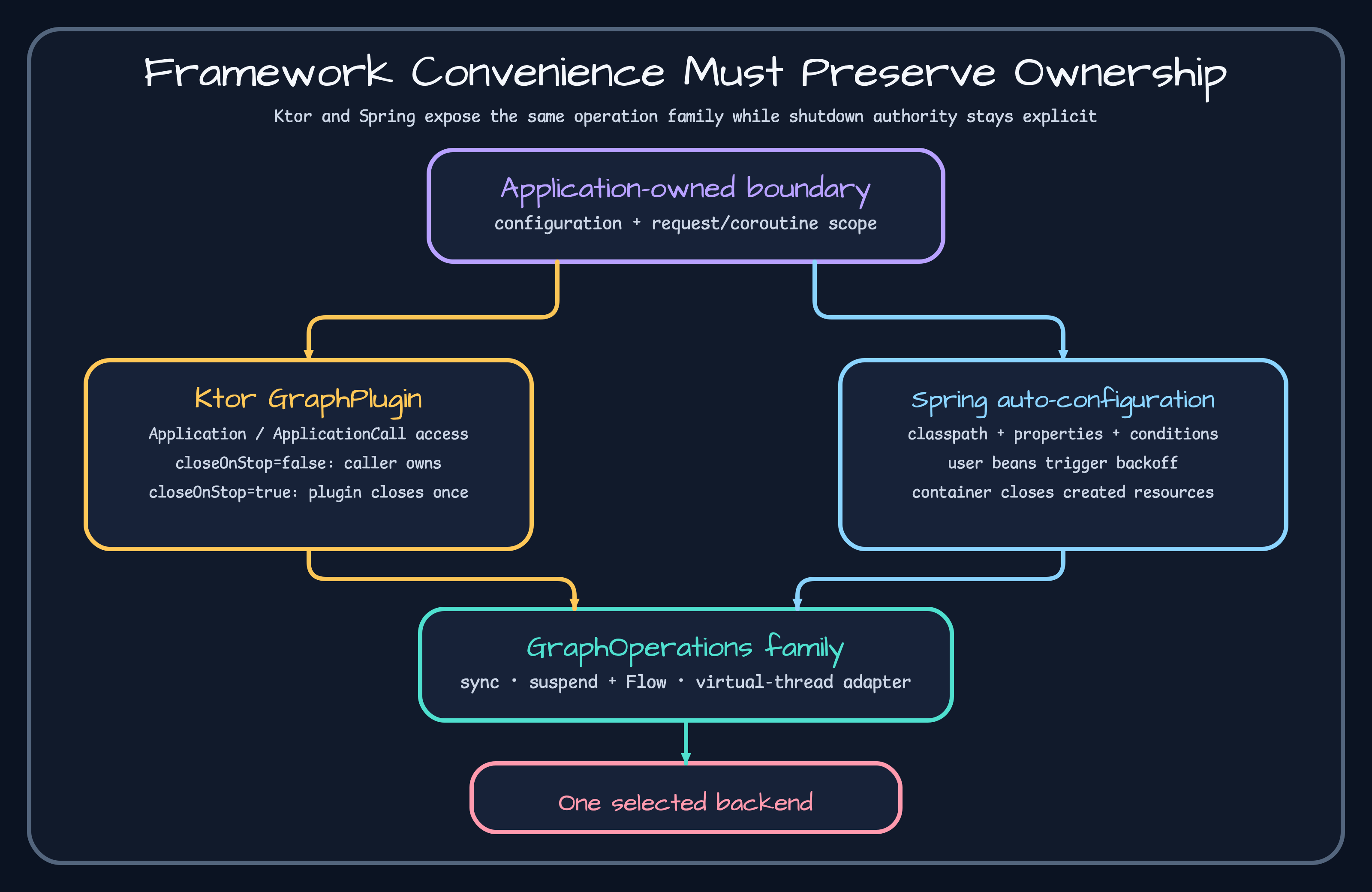
Install GraphPlugin once in a Ktor application and select a backend or supply sync/suspend operations. Installation fails if configuration resolves no backend. The resulting GraphPluginState is stored in application attributes: GraphPlugin.kt, GraphPluginConfig.kt.
fun Application.module() { install(GraphPlugin) { tinkerGraph() } routing { /* graphOperations() / graphSuspendOperations() */ }}Lifetime is application-scoped, not request-scoped. On ApplicationStopped, only close actions registered by configuration run. Caller-owned drivers and data sources remain caller-owned. Verify startup, attribute lookup, and exactly-once close behavior with GraphPluginTest.kt and BackendGraphPluginRuntimeTest.kt.
Diagnose install-time errors before routing errors. In production, observe application stop events, driver pool metrics, request cancellation, and whether request handlers use the API matching their coroutine/blocking model.
Dependency, managed configuration, and route access
Section titled “Dependency, managed configuration, and route access”dependencies { implementation(platform("io.github.bluetape4k:bluetape4k-dependencies:<ecosystem-version>")) implementation("io.github.bluetape4k:bluetape4k-graph-ktor") implementation("io.github.bluetape4k:bluetape4k-graph-neo4j")}
fun Application.module() { install(GraphPlugin) { neo4j { uri = "bolt://localhost:7687" username = "neo4j" password = System.getenv("NEO4J_PASSWORD") database = "neo4j" } } routing { get("/people/count") { call.respondText(call.graphSuspendOperations().countVertices("Person").toString()) } }}Expected: plugin state is available after installation and the route returns the current count. Starting with install(GraphPlugin) {} must fail immediately with A graph backend must be selected...; calling graphSuspendOperations() without installation must fail with GraphPlugin is not installed....
Verify shutdown and diagnose ownership
Section titled “Verify shutdown and diagnose ownership”The managed neo4j { ... } DSL creates and closes operations plus Driver on ApplicationStopped. A preconstructed pair follows the separate GraphPluginConfig.operations contract:
// Default: the caller or DI container closes both operations.install(GraphPlugin) {    operations(sync, suspend) // closeOnStop = false}
// Explicit handoff: the plugin closes the operations on ApplicationStopped.install(GraphPlugin) {    operations(sync, suspend, closeOnStop = true)}
Only the closeOnStop = true branch registers close actions and deduplicates the two operations by object identity before closing each object once. With the default false, the plugin closes neither operations object. In both branches, a Driver used to construct those operations remains separately caller-owned because graph operations do not close an injected Driver. Test both alternatives:
./gradlew :bluetape4k-graph-ktor:test --tests '*GraphPluginTest' --tests '*BackendGraphPluginRuntimeTest'If shutdown logs appear but the pool remains open, identify which configuration path created the Driver before adding another close hook; double-closing caller-owned infrastructure is a lifecycle bug.