
FalkorDB
Archived Based on Graph release 0.5.1
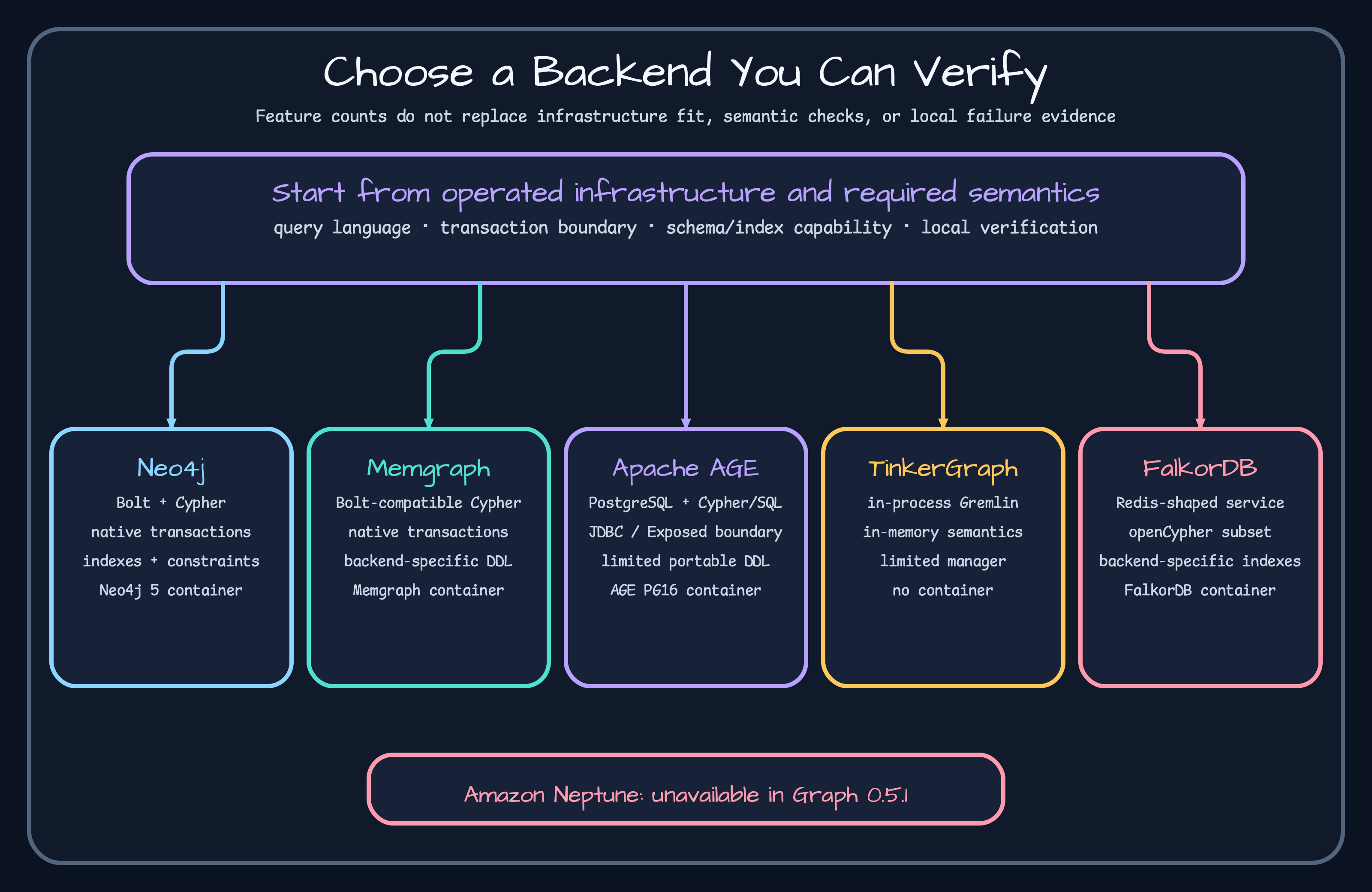
Choose FalkorDB when a Redis-shaped deployed service and its openCypher subset match the system boundary. The module uses jfalkordb; do not treat it as a drop-in Neo4j server merely because both accept Cypher-like queries.
Read FalkorDBGraphOperations.kt and FalkorDBGraphSchemaManager.kt. Container-backed CRUD, merge, batch, and schema evidence is in FalkorDBGraphOperationsTest.kt and neighboring tests.
Transaction semantics are the main portability boundary. In 0.5.1 the suspend transaction test records an unsupported repository DSL path rather than pretending atomicity: FalkorDBGraphSuspendOperationsTest.kt. Design multi-write workflows around verified server/library guarantees.
Observe pool/Redis connectivity, query latency, memory, slow queries, and index creation. Reproduce against the release container, then the exact production image and configuration.
Start the verified server/client path
Section titled “Start the verified server/client path”dependencies { implementation(platform("io.github.bluetape4k:bluetape4k-dependencies:<ecosystem-version>")) implementation("io.github.bluetape4k:bluetape4k-graph-falkordb")}./gradlew :bluetape4k-graph-falkordb:test --tests '*FalkorDBGraphOperationsTest'./gradlew :bluetape4k-graph-falkordb:test --tests '*FalkorDBGraphSuspendOperationsTest'In the fixture, create two vertices and an edge, then call neighbors. Expected: the container-backed client returns the target vertex and schema tests report the indexes FalkorDB actually exposes. Next run suspendTransaction { ... }: the 0.5.1 test expects the repository DSL path to be unsupported, not rolled back as a native multi-statement transaction.
Diagnose server and transaction restrictions
Section titled “Diagnose server and transaction restrictions”If connection succeeds but transaction assertions fail, do not add a client-side read/write fallback. Split the workflow into explicitly idempotent operations or choose a backend with the required atomic boundary. Diagnose server readiness, authentication/network, client pool, query subset, then index support in that order. The fixture owns the server and created client; externally supplied clients stay caller-owned.