
Choose an election model
Archived Based on Leader release 0.4.0
Select single, bounded group, or strategic election from the work’s concurrency and placement rules.
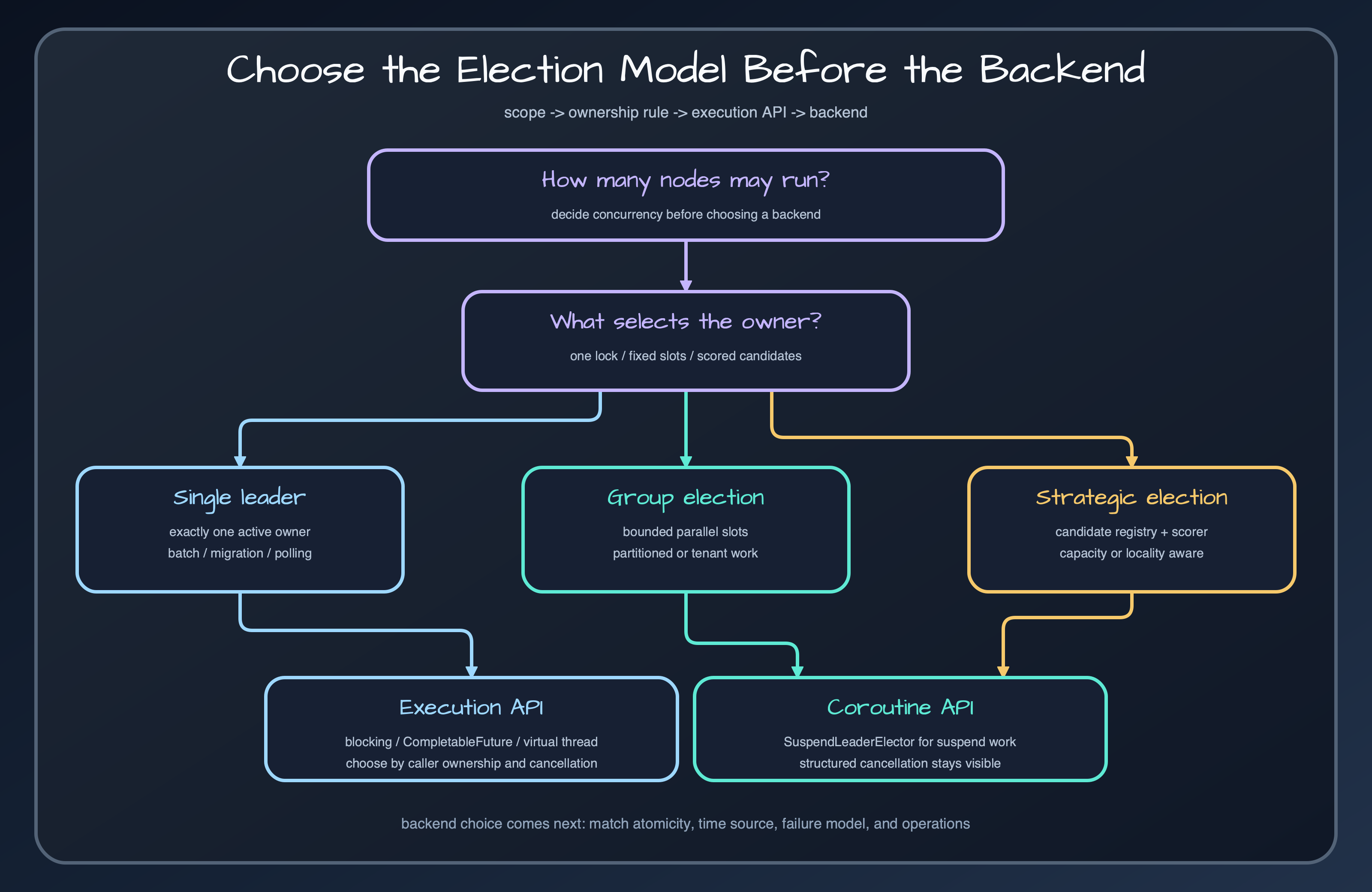
Single leader
Section titled “Single leader”Use LeaderElector or SuspendLeaderElector when at most one instance may execute a named action. Scheduled settlement, migration gates, and control-plane reconciliation are typical cases. The lock name is the concurrency boundary.
Leader group
Section titled “Leader group”Use LeaderGroupElector when up to maxLeaders workers may run concurrently. Each winner owns a slot. This is a distributed semaphore, not work distribution: the application still needs a queue or partitioning rule so two elected workers do not process the same item.
Strategic election
Section titled “Strategic election”Use strategic election when the winner should be selected by candidate information rather than whoever acquires a lock first. FIFO, deterministic random, scored, and weighted scoring are available. Candidate registration and selection introduce freshness requirements; stale candidate data can choose an unsuitable node.
Decision rule
Section titled “Decision rule”Start with single leader. Move to a group only when measured throughput requires bounded parallelism. Choose strategic election only when placement quality is itself a requirement and you can maintain candidate health data.
Release sources
Section titled “Release sources”leader-core/src/main/kotlin/io/bluetape4k/leader/LeaderElector.ktleader-core/src/main/kotlin/io/bluetape4k/leader/LeaderGroupElector.ktleader-core/src/main/kotlin/io/bluetape4k/leader/StrategicLeaderElector.kt