
Choosing a Cache Backend
Archived Based on Exposed release 1.11.0
The first decision is not the Redis client. Decide who must observe the same cached value, how long stale data is acceptable, and when a successful write must already be durable in the database.
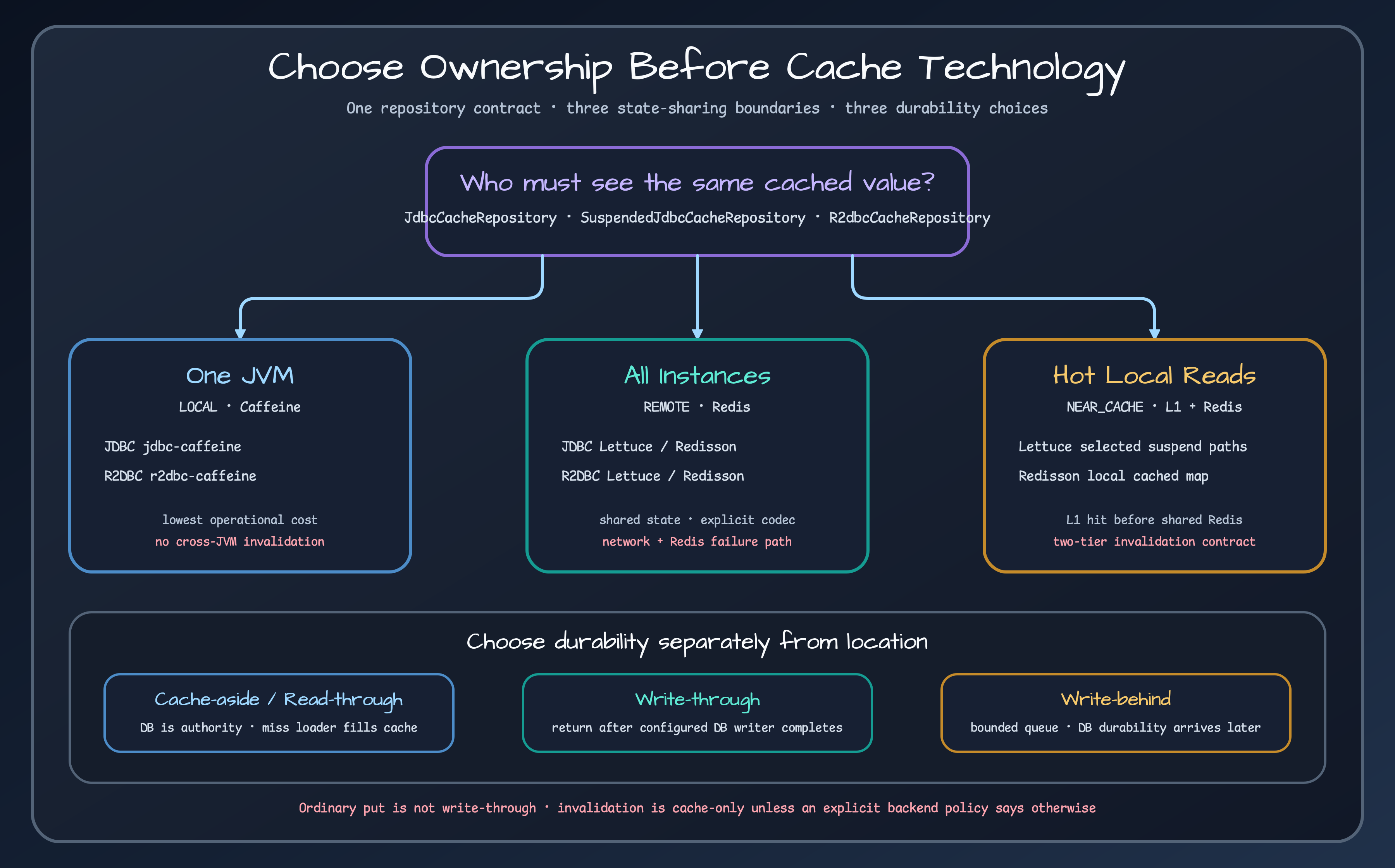
Start with the sharing boundary
Section titled “Start with the sharing boundary”| Need | Start with | Why | Main cost |
|---|---|---|---|
| One application process | Caffeine | No network or external service | Every JVM owns different state |
| Shared state across instances | Lettuce or Redisson remote cache | Redis is the common state owner | Network and Redis become part of availability |
| Hot local reads plus shared Redis | Near Cache | L1 avoids some round trips | Two tiers must invalidate and expire coherently |
Choose JDBC or R2DBC independently from the cache backend. JDBC adapters provide blocking paths, with suspended JDBC variants where available. R2DBC adapters keep repository operations suspend; that changes cancellation and transaction ownership, not the cache consistency model.
Then choose the write contract
Section titled “Then choose the write contract”| Pattern | Read miss | Write owner | Return means | Use when |
|---|---|---|---|---|
| Cache-aside | Application loads DB and caches | Application transaction | DB commit completed; invalidation may still fail | Existing service owns writes |
| Read-through | Loader reads DB | Cache loader | Miss load completed | Repository should centralize miss handling |
| Write-through | Configured writer updates DB | Cache map writer | DB write completed or failed | Synchronous durability is required |
| Write-behind | Loader still handles reads | Bounded async writer | Cache accepted the write; DB may not be committed | Delayed durability and loss window are acceptable |
| Invalidation | No load | Cache only by default | Selected cache state was removed | DB remains the authority |
An ordinary put is not proof of write-through. Check CacheWriteMode, LettuceCacheConfig/RedissonCacheConfig, and whether the concrete map has a database writer.
Backend comparison
Section titled “Backend comparison”| Concern | Caffeine | Lettuce | Redisson |
|---|---|---|---|
| Location | In-process | Redis; selected paths add Caffeine near cache | Redis RMap/RLocalCachedMap |
| Key/value contract | Prefix plus local ID/value | Explicit RedisCodec<String, E>; TTL applied on set | Configured Redisson codec; unsafe binary families require trust opt-in |
| Client lifecycle | Repository owns local cache/scope | Application owns RedisClient; repository closes connection | Application owns RedissonClient |
| Partial failure | Queue saturation or process loss | Redis timeout/retry, dead letter, DB failure | Redis future, writer/DB failure, optional DB deletion on invalidation |
| Isolation | Unique prefix per test | Isolated Redis and prefix | Isolated Redis and map name |
Lettuce is a good fit when the application wants explicit codecs and connection control. Redisson is a good fit when its loaded-map and local-cached-map policy is useful. That is an ownership decision, not a universal performance ranking.
TTL, invalidation, and stale data
Section titled “TTL, invalidation, and stale data”Set TTL from the business staleness budget. In a local cache, another instance cannot see invalidation. In a near cache, both L1 and Redis must be cleared or synchronized. For Redisson, deleteFromDBOnInvalidate=false is the safe default: turning it on changes a cache operation into database deletion.
Key prefixes, cache names, codecs, and entity schemas are stored-data contracts. Roll out a migration or versioned namespace when any of them changes. Do not silently reinterpret old Redis bytes with a new codec.
Failure and shutdown checklist
Section titled “Failure and shutdown checklist”- Decide whether a cache backend outage fails the request, bypasses cache, or allows stale local data.
- Bound retries, timeouts, write-behind queues, and shutdown drain time.
- Observe queue depth, rejected writes, dead letters, circuit state, and invalidation lag.
- Close repositories before application-owned Redis clients.
- Test cancellation around R2DBC and suspended JDBC paths.
- Use unique namespaces and clear them in test teardown.
Recommended learning path
Section titled “Recommended learning path”Begin with Exposed cache foundation. Implement one backend in READ_ONLY/read-through mode, prove cache-only invalidation, then add the write policy. Near cache and write-behind should be the last steps because they add a second consistency boundary or a delayed durability window.