
AWS Service Learning Paths
Archived Based on AWS release 0.4.0
Learn one complete service path at a time: dependency, client, application boundary, integration test, then operations. The examples below contain runnable code and emulator-backed tests, so they are more useful than copying isolated API calls.
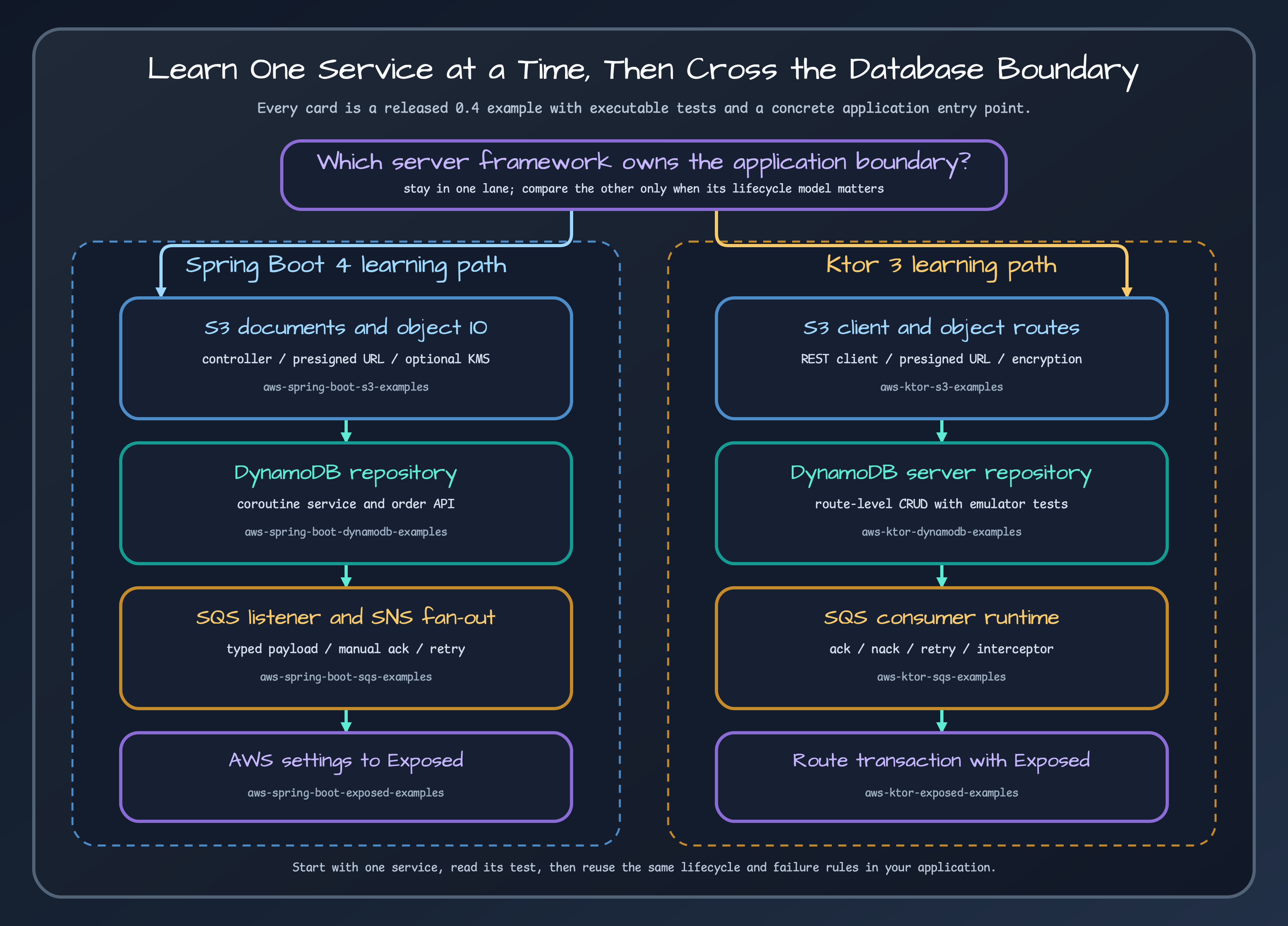
S3: object lifecycle before advanced features
Section titled “S3: object lifecycle before advanced features”- Start with the Java or Kotlin SDK S3 helpers to understand upload, download, listing, copy/move, and delete behavior.
- Choose the application edge:
S3CoroutinesTemplate/S3Operationsin Spring Boot orS3KtorClientin Ktor. - Run one of the S3 examples and inspect both the HTTP route and the test fixture.
- Add presigned URLs, multipart transfer, client-side encryption, Access Grants, or S3 Vectors only after the object and ownership path works.
- Ktor S3 example covers object routes, presigned URLs, content-type detection, configuration objects, and client-side encryption.
- Spring Boot S3 example covers WebFlux endpoints,
S3Operations,S3CoroutinesTemplate, presigned URLs, and optional KMS-backed client-side encryption.
Presigning proves request construction, not IAM authorization at execution time. Test the generated request against the intended endpoint and credential model.
DynamoDB: key model before repository convenience
Section titled “DynamoDB: key model before repository convenience”- Define partition and sort keys, access patterns, conditional writes, and table naming before selecting repository helpers.
- Use the Java SDK enhanced repository when enhanced table schemas are part of the design, or the Kotlin SDK/Ktor repository when native suspend clients are the primary path.
- Test create/read/update/delete and the conditions that prevent lost updates or duplicate writes.
- Keep table auto-creation restricted to explicitly registered definitions; production schema ownership should remain deliberate.
- Ktor DynamoDB example shows plugin configuration, table setup, mapper, repository, routes, and Floci/LocalStack tests.
- Spring Boot DynamoDB example shows a coroutine repository behind a small REST API and auto-configured clients.
SQS and SNS: delivery semantics before throughput
Section titled “SQS and SNS: delivery semantics before throughput”- Choose acknowledgement behavior, visibility timeout, retry/backoff, idempotency key, and redrive policy.
- For SQS consumers, decide whether success deletes automatically or handlers acknowledge manually.
- Test handler failure, conversion failure, redelivery, and shutdown with in-flight messages.
- Add SNS fanout only after the queue consumer contract is observable and idempotent.
- Ktor SQS example demonstrates manual ack/nack, retry-once redelivery, interceptors, and observer events.
- Spring Boot SQS/SNS example demonstrates typed listeners, manual acknowledgement, retry/backoff, interceptor events, and SNS-to-SQS fanout.
An emulator can verify API and integration behavior, but it does not prove production IAM, queue policy, throttling, or exactly-once processing. SQS is at-least-once delivery; business handlers must tolerate duplicates.