Choosing AWS SDK for Java v2 or AWS SDK for Kotlin
Archived Based on AWS release 0.4.0
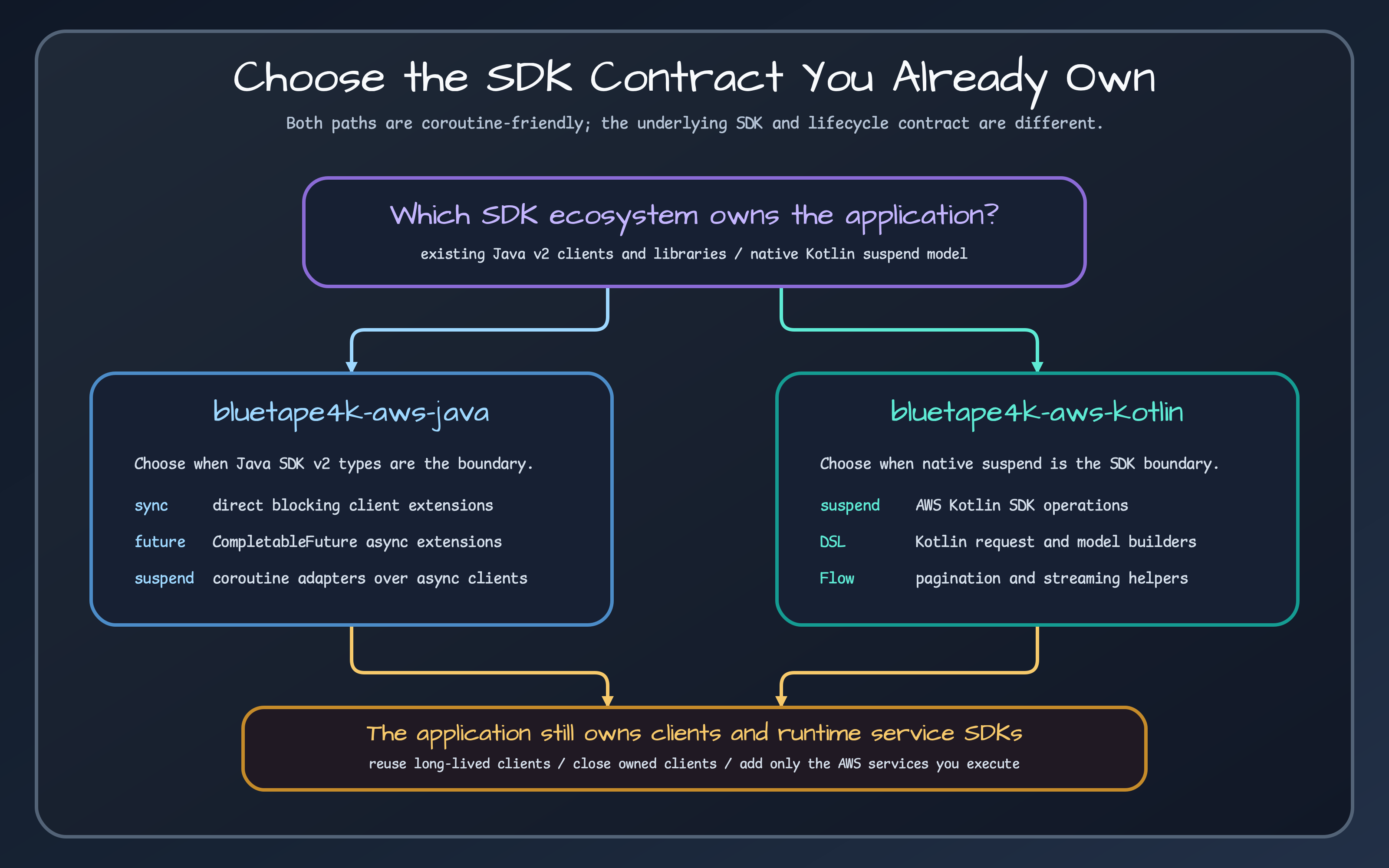
Both paths support coroutine-based application code, but they reach it differently. Choose by the client model, required AWS feature, and surrounding libraries—not by whether the calling function is marked suspend.
Decision table
Section titled “Decision table”| Question | Java SDK v2 path | Kotlin SDK path |
|---|---|---|
| Existing client estate | Best when Java SDK v2 clients are already shared | Best when the service is Kotlin SDK-first |
| Async model | CompletableFuture with suspending adapters | Native suspending operations |
| DynamoDB | Standard and enhanced clients, table schemas, coroutine repository | Native client, request DSLs, batch executor |
| S3 transfer | Java transfer manager and async client extensions | Kotlin client object helpers |
| Framework use in this release | Spring Boot integrations primarily build Java SDK clients | Ktor DynamoDB integration uses Kotlin SDK; other Ktor features may use Java SDK clients or Ktor HTTP |
| HTTP transport | AWS Java SDK HTTP client implementations | Smithy Kotlin CRT/OkHttp engines |
| Lifecycle concern | Close sync/async clients and their owned transport | Close clients; close explicitly shared engines separately |
Choose Java SDK v2 when interoperability leads
Section titled “Choose Java SDK v2 when interoperability leads”Use bluetape4k-aws-java when the application already exposes Java SDK clients, needs enhanced DynamoDB APIs, uses the S3 transfer manager, or integrates with Spring Boot auto-configuration in this repository. The library offers three surfaces where supported: direct sync helpers, async CompletableFuture extensions, and suspending extensions over async clients.
The suspending surface does not turn a sync client into non-blocking I/O. Use the async client extensions when coroutine cancellation and non-blocking transport are part of the design.
Choose the Kotlin SDK when the suspend model leads
Section titled “Choose the Kotlin SDK when the suspend model leads”Use bluetape4k-aws-kotlin when AWS SDK for Kotlin is the primary client layer. Its service clients already expose suspending operations; bluetape4k adds request builders, mapping helpers, batch execution, and higher-level flows such as Kinesis records.
The Kotlin SDK path still has resource ownership. A client-managed HTTP engine closes with the client. An explicitly supplied shared engine does not, so the application must close it after all clients.
Mixing paths deliberately
Section titled “Mixing paths deliberately”Some applications legitimately use both. A Ktor service can use the Kotlin SDK DynamoDB plugin and a Java SDK SQS consumer. Treat that as two explicit runtime stacks:
- configure region, credentials, endpoint overrides, retries, and timeouts for each;
- avoid translating models between SDKs in domain code;
- record which component closes each client and engine;
- test both emulator paths independently.
If the same service can be implemented entirely on one SDK, the simpler ownership model usually outweighs small syntax differences.